
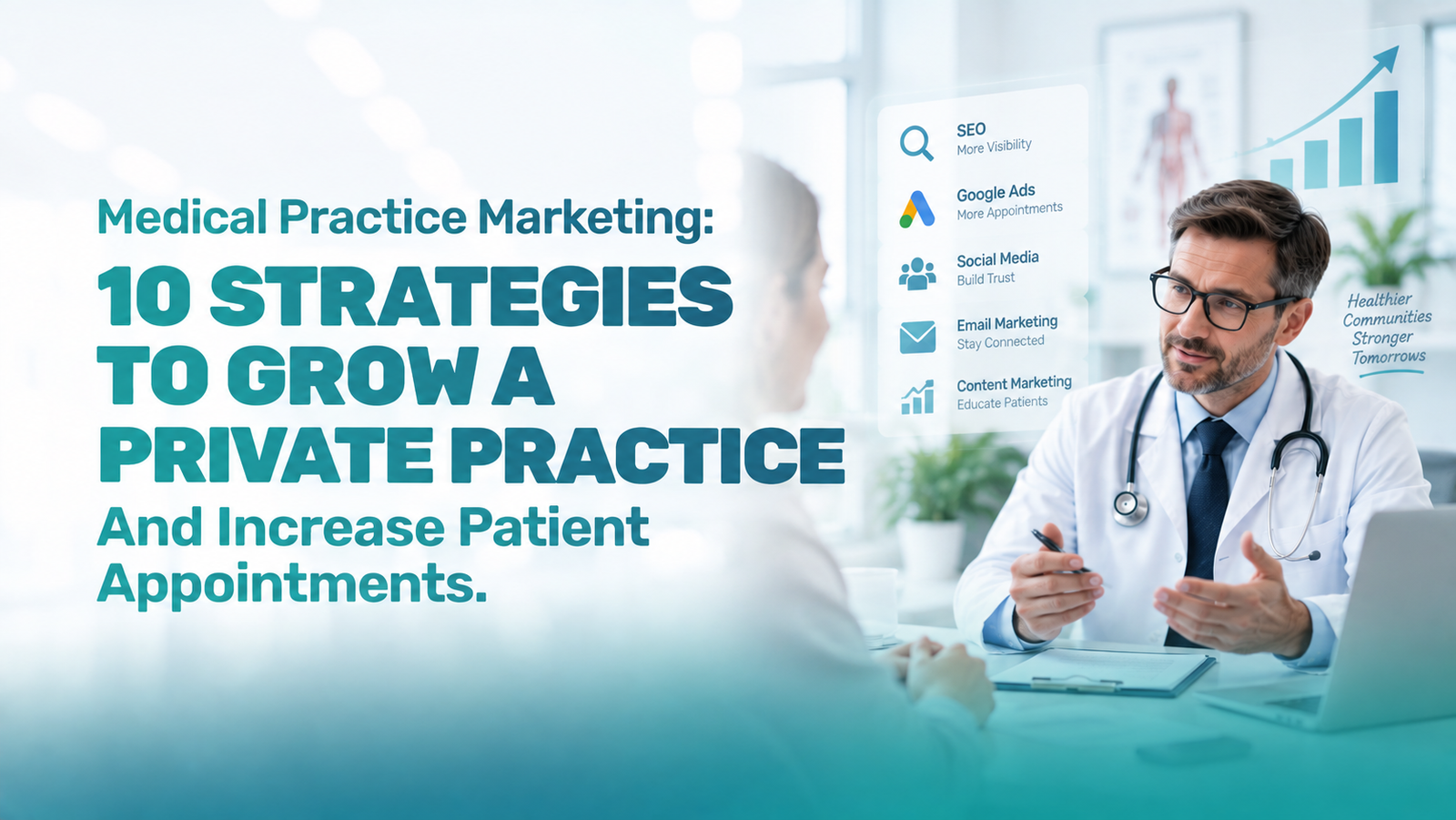
Growing a private medical practice requires more than clinical expertise and occasional advertising.
Doctors today operate in an environment where patients can compare providers, read reviews, research treatments and evaluate practices before ever speaking to the front desk.
Effective medical practice marketing therefore needs to influence the entire patient journey — from discovery to appointment and, ultimately, long-term trust.
Here are 10 strategies doctors can use to build a more structured patient acquisition system.
1. Define What the Practice Wants to Be Known For
Trying to market every service equally can weaken positioning. Practices should identify their priority specialities, procedures, patient populations and geographic markets.
Clear positioning makes every subsequent marketing decision easier.
2. Build a Conversion-Focused Medical Website
A website should quickly communicate:
- Who the physicians are
- What they treat
- Where they practise
- Why patients should consider them
- How appointments can be requested
The website should function as the centre of the practice’s digital patient journey.
3. Invest in SEO for Doctors
SEO for doctors helps practices become discoverable when patients actively search for care.
Treatment pages, condition pages, local SEO, physician profiles and educational content can create sustainable organic visibility.
The objective should be relevant patient traffic rather than traffic alone.
4. Strengthen Local Search Visibility
For most private practices, geography matters.
Optimising Google Business Profile information, maintaining consistent practice details and developing location-relevant website content can improve visibility for local patient searches.
5. Use Google Ads for High-Intent Demand
Google Ads for doctors can place a practice in front of patients already searching for relevant services.
Campaigns should prioritise treatment intent, geographic relevance and measurable appointment outcomes instead of broad awareness alone.
6. Build Physician Authority
Patients often research the doctor before scheduling. Educational videos, articles, FAQs, interviews and clinically useful content can demonstrate expertise.
Healthcare content should educate rather than exaggerate. Authority is stronger when patients can understand how the physician thinks.
7. Manage Online Reputation Professionally
Reviews can influence patient decisions, particularly when several comparable practices appear in search results.
Practices should develop ethical systems for requesting genuine patient feedback and responding professionally to reviews while respecting privacy obligations.
Reputation management should never involve fabricated testimonials or misleading review practices.
8. Improve Lead-to-Appointment Conversion
Generating an enquiry is only half the job.
Medical practices should track:
- Missed calls
- Response time
- Form enquiries
- Follow-up
- Appointment scheduling
- No-shows
A practice spending heavily on marketing while ignoring front-desk conversion may simply be paying to generate lost opportunities.
9. Build Patient Retention and Referral Systems
Practice growth does not always require continuously acquiring new patients.
Depending on the speciality, appropriate follow-up communication, continuity of care, patient education and strong patient experiences can support retention and referrals.
Word of mouth remains particularly powerful in healthcare because patients often seek reassurance from people they trust.
10. Measure Marketing Against Business Outcomes
Followers, impressions and website traffic can provide useful diagnostic information, but they should not become the final definition of success.
A stronger healthcare marketing strategy measures:
Visibility → Enquiries → Appointments → Patients → Revenue
Practices can then determine which channels, services and geographic markets are actually contributing to growth.
Build a Patient Acquisition System – Not 10 Disconnected Activities
The biggest mistake in private practice marketing is treating each activity independently.
One agency runs Google Ads.
Someone else posts on Instagram.
A freelancer manages SEO.
The receptionist handles enquiries.
Nobody connects the data.
Instead, practices should think about the complete journey:
Patient searches → Discovers practice → Evaluates doctor → Visits website → Enquires → Receives response → Books appointment → Experiences care → Returns or refers
Every stage affects the next.
Final Thoughts
The most effective medical practice marketing strategies are not necessarily the loudest.
They are the most connected.
SEO creates discoverability. Paid search captures immediate demand. Content builds physician authority. A strong website converts attention into enquiries. Efficient front-desk systems turn enquiries into appointments. Patient experience creates retention and referrals.
When these elements operate as one system, marketing becomes much more than promotion.
It becomes infrastructure for practice growth.
For doctors building private practices in competitive US healthcare markets, that distinction matters.
More marketing activity is not necessarily the answer. A better patient acquisition system often is.