
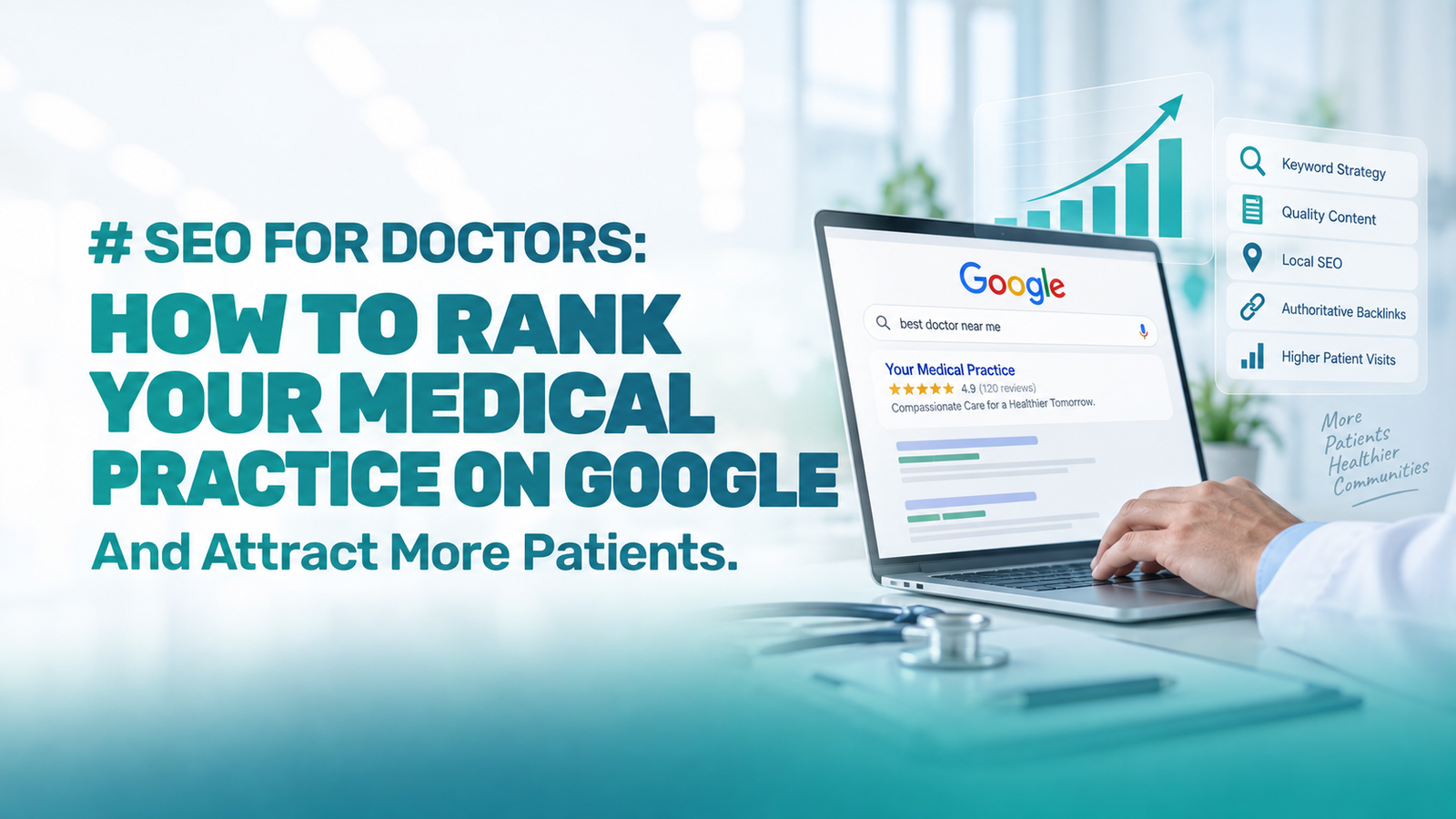
When patients need medical care, one of their first actions is often to search online.
They may search for a doctor, medical condition, procedure or healthcare provider nearby. For private practices, appearing during these high-intent searches can directly influence patient discovery.
This is why SEO for doctors has become an important component of modern medical practice marketing.
But effective medical SEO is not about ranking for hundreds of random keywords.
The objective is to appear for searches that have a realistic chance of turning into patient appointments.
What Is SEO for Doctors?
Search Engine Optimisation, or SEO, is the process of improving a medical practice’s website and online presence so that search engines can better understand its relevance to patient searches.
For example, an orthopedic practice may want visibility for searches such as:
- Orthopedic surgeon near me
- Knee replacement surgeon
- Sports injury doctor
- Hip replacement surgeon in [city]
A rheumatology practice may instead target searches related to rheumatoid arthritis, gout, ankylosing spondylitis or rheumatologists within its service area.
Successful SEO for medical practices therefore begins with patient search behaviour.
1. Target Treatment-Intent Keywords
Search volume alone should never determine an SEO strategy.
A keyword generating 10,000 informational searches may produce fewer patients than a treatment-specific keyword searched only several hundred times.
Doctors should identify keyword clusters around:
- Medical speciality
- Conditions treated
- Procedures offered
- Physician searches
- Geographic searches
- “Near me” searches
- Appointment and consultation intent
Commercial relevance matters as much as search volume.
2. Build Dedicated Treatment and Condition Pages
Many medical websites make the mistake of placing every service on one generic page.
Instead, important services should have detailed, useful pages of their own.
A joint replacement practice, for example, might require separate pages for:
- Knee replacement
- Hip replacement
- Partial knee replacement
- Robotic joint replacement
- Revision surgery
This creates greater topical clarity for search engines while providing patients with more relevant information.
3. Local SEO Is Critical for Private Practices
Most independent medical practices serve defined geographic markets.
This makes local SEO for doctors particularly important.
Practices should maintain consistent information about:
- Physician name
- Practice name
- Address
- Phone number
- Opening hours
- Services
- Website
The Google Business Profile should also be properly maintained.
For multi-location practices, each legitimate practice location may require its own local SEO strategy and appropriately structured website content.
4. Publish Content Based on Patient Questions
Blogs can help a medical website build topical depth. However, publishing generic health articles simply to increase traffic is rarely enough. Content should answer questions patients actually ask before making healthcare decisions.
Examples include:
“How long does recovery after hip replacement take?”
“When should someone see a rheumatologist?”
“What should patients expect after cataract surgery?”
Educational content can attract earlier-stage patients while strengthening the website’s overall authority around relevant clinical topics.
5. Technical SEO Cannot Be Ignored
Strong content performs better when supported by a technically sound website.
Important elements of healthcare SEO include:
- Mobile usability
- Website speed
- Logical URL structures
- Internal linking
- Crawlability
- Secure HTTPS
- Structured data where appropriate
- Correct page titles and descriptions
An outdated or technically weak website can limit the effectiveness of otherwise strong content.
6. Build Around Expertise and Trust
Healthcare is a high-trust category.
Medical websites should make it easy for patients and search engines to understand who created or reviewed medical content.
Physician biographies, qualifications, clinical areas of focus, authorship information and properly referenced educational content can contribute to a stronger website.
Doctors should avoid publishing large volumes of generic or automatically generated medical content with little clinical value.
Quality matters.
7. Measure Patient Acquisition — Not Just Rankings
Ranking first for a keyword is useful only if it contributes to meaningful business outcomes.
Private practices should evaluate:
Organic Traffic → Enquiries → Appointments → Patients
They should also identify which treatments and locations generate commercially valuable organic enquiries.
This changes SEO from a visibility exercise into a measurable patient acquisition strategy.
Final Thoughts
Effective SEO for doctors combines patient search intent, medical content, local visibility, technical optimisation and conversion strategy.
The goal should never be to rank for everything.
It should be to become highly visible for the searches that matter most to the practice.
For doctors investing in long-term growth, a well-structured medical SEO strategy can help build sustained patient discovery without relying entirely on paid advertising.
In healthcare SEO, traffic is useful.
Relevant patient intent is considerably more valuable.