Healthcare is one of the most trusted professions in the world. Yet, when it comes to marketing, many hospitals struggle to see meaningful results. Despite spending significant budgets on digital campaigns, social media posts, and advertising, the outcome often remains the same — inconsistent patient flow, unpredictable enquiries, and rising acquisition costs.
The problem is rarely the effort.
The problem is the approach.
Hospital marketing fails when it is treated like general business advertising. Healthcare operates on a completely different set of principles — trust, timing, clinical authority, and patient confidence. When these factors are ignored, marketing becomes noise instead of a growth engine.
In this article, we explore why hospital marketing fails and how hospitals can build a predictable patient acquisition system that consistently brings qualified patients.
1. Marketing Is Treated as Promotion Instead of Strategy
One of the most common mistakes hospitals make is treating marketing as a promotional activity rather than a structured growth strategy.
Many hospitals invest in:
- Random social media posts
- Occasional advertising campaigns
- Inconsistent website updates
- Generic digital marketing services
While these activities create visibility, they rarely create predictable patient acquisition.
Hospital marketing must be built around patient demand, treatment intent, and conversion systems. Without a structured strategy, marketing activities remain disconnected from actual patient growth.
A predictable patient acquisition system begins with a simple question:
Which patients are we trying to attract, and what treatments do they need?
Once this is clear, marketing can be aligned with real healthcare demand rather than generic promotion.
2. Most Marketing Agencies Do Not Understand Healthcare
Healthcare marketing is fundamentally different from marketing in other industries.
In retail or FMCG, marketing focuses on impulse decisions.
In healthcare, patients take decisions based on trust, expertise, and urgency.
Most general digital marketing agencies do not understand key healthcare dynamics such as:
- OPD vs IPD conversion funnels
- Treatment acceptance psychology
- Patient counselling processes
- Clinical authority building
- Referral networks
- Geographic healthcare demand
As a result, hospitals often receive reports showing impressions, clicks, and reach — but not actual patient conversions.
For hospital owners and healthcare CXOs, the only metrics that matter are:
- Number of qualified patient enquiries
- OPD visits
- Treatment conversions
- Revenue growth
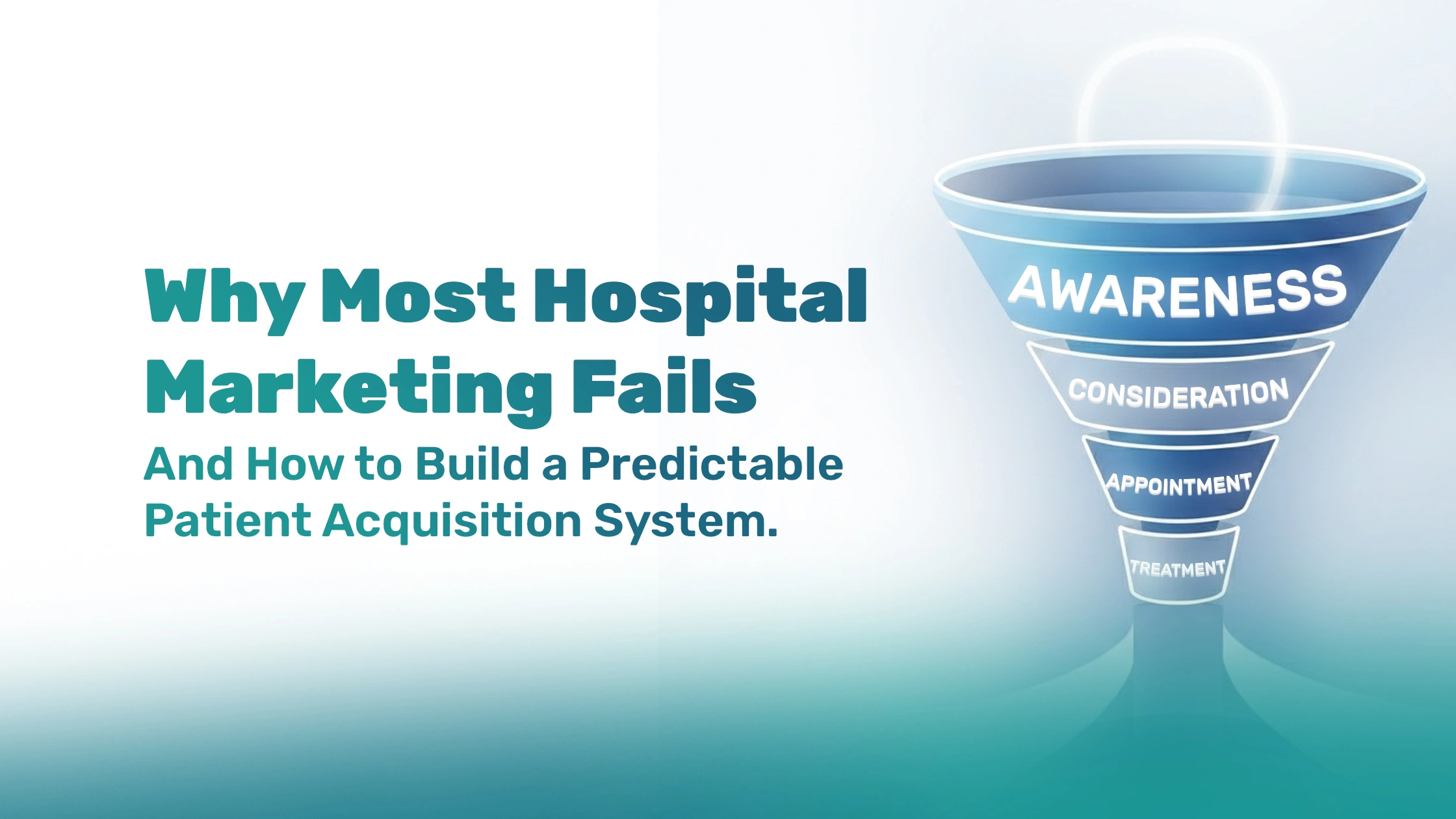
A marketing system must therefore track and optimise the entire patient journey — from the first search online to the final consultation.
3. Lack of High-Intent Patient Targeting
Another major reason hospital marketing fails is poor targeting.
Not every online user is a potential patient.
Hospitals must focus on high-intent searches and treatment-driven demand.
For example, patients searching for:
- “Best orthopedic surgeon near me”
- “Cost of knee replacement surgery in India”
- “IVF specialist in [city]”
- “Treatment for slipped disc”
are already close to making a medical decision.
If hospitals dominate these high-intent searches through SEO and performance marketing, they capture patients who are actively seeking treatment.
Without this approach, marketing campaigns attract low-quality traffic that rarely converts into consultations.
4. Weak Trust Signals
Healthcare decisions are deeply emotional. Patients do not choose hospitals based only on convenience; they choose hospitals they trust.
Many hospital websites and digital platforms fail to communicate trust effectively.
Common problems include:
- Generic website content
- Lack of doctor authority profiles
- Poor explanation of treatment outcomes
- Inconsistent brand presentation
- Limited patient education resources
Strong healthcare brands consistently communicate:
- Doctor expertise
- Clinical experience
- Treatment capabilities
- Patient care philosophy
When these trust signals are clear, patients feel more confident scheduling consultations.
5. No System for Converting Enquiries into Patients
Even when hospitals generate enquiries, many fail to convert them into consultations.
This often happens because of:
- Slow response times
- Poor enquiry management
- Lack of counselling frameworks
- Unstructured follow-up processes
A predictable patient acquisition system must integrate marketing with patient coordination and counselling.
Hospitals that respond quickly, educate patients effectively, and guide them through treatment decisions see significantly higher conversion rates.
Marketing generates enquiries, but systems convert them into patients.
How to Build a Predictable Patient Acquisition System
Hospitals that consistently grow their patient base follow a structured approach that combines branding, performance marketing, and operational alignment.
A predictable system typically includes the following components.
Clear Speciality Positioning
Hospitals must define their strongest clinical departments and build authority around them. Instead of promoting everything equally, marketing should prioritise high-impact specialities and treatments.
High-Intent Search Visibility
Hospitals must dominate search results for treatment-specific queries in their region. This requires strong healthcare SEO and targeted performance marketing campaigns.
Authority-Driven Content
Educational content plays a crucial role in healthcare marketing. Blogs, videos, and patient guides help establish doctors as trusted experts, increasing patient confidence before the first visit.
Conversion-Optimised Websites
Hospital websites must guide patients smoothly from awareness to enquiry. Clear treatment pages, doctor profiles, and patient information improve engagement and conversion rates.
Integrated Patient Response Systems
Every enquiry should be handled quickly and professionally. Hospitals that integrate marketing with patient coordinators see higher consultation rates and improved treatment acceptance.
The Long-Term Impact of a Strong Patient Acquisition System
Hospitals that implement structured marketing systems experience several long-term benefits.
These include:
- Consistent patient inflow
- Reduced dependency on referrals alone
- Improved brand authority in the region
- Higher treatment acceptance rates
- Lower patient acquisition costs over time
Most importantly, hospitals gain the ability to predict and plan growth, which is essential for expansion and investment decisions.
Final Thoughts
Hospital marketing should not be viewed as a series of promotional activities. When executed correctly, it becomes a strategic growth engine that brings the right patients, strengthens trust, and improves long-term revenue stability.
The key lies in building a predictable patient acquisition system — one that combines healthcare branding, search visibility, authority-driven communication, and strong conversion processes.
Hospitals that approach marketing with this level of structure and clarity are far more likely to achieve sustainable growth in an increasingly competitive healthcare landscape.